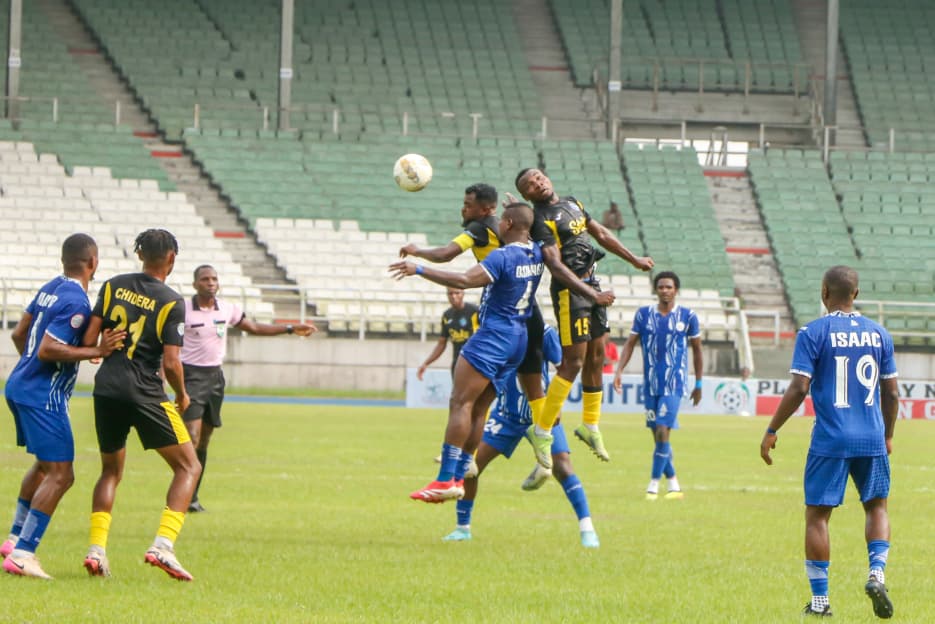
A new season affords every club an opportunity to make a fresh start. The slate is wiped clean, the points tally reset to zero, and every team begins on equal footing. While no points are carried over from the previous campaign, the lessons learned can shape the response that follows—whether to consolidate on success or recover from disappointment.
Pre-season provides club management with the time and space to set the tone for the campaign ahead. Goals are defined, the right personnel assembled, and the foundation laid for achieving those objectives. Coaches establish the team’s technical direction, while players are put through their paces to attain peak physical condition and buy into the club’s vision.
One area that significantly contributed to Enyimba’s disappointing league finish last season was the defence. The numbers are so alarming that revisiting them leaves a grim feeling. As the timeless quote attributed to Sir Alex Ferguson reminds us, “Attack wins you matches, but defence wins you titles.”
A review of every full 20-team NPFL season since 2004/05 supports that statement. Sixty percent of eventual league champions finished with the best defensive record, while the remaining forty percent were never far behind.
Last season, champions Rangers conceded just 27 goals. Enyimba, by contrast, finished joint 16th defensively after shipping a staggering 42 goals—the highest number the People’s Elephant have conceded in the league during the period under review.
It is even more remarkable when one considers that only two seasons earlier, Rangers and Enyimba both finished with 33 goals conceded, jointly ranking second-best defensively. The title race between both clubs was only decided in the penultimate match of the 2023/24 season. What a difference two years can make in the life of a football club.
Enyimba still holds the record for the fewest goals conceded in a league season—just 19 during the 2012/13 campaign. That remarkable season also saw the People’s Elephant go the entire league campaign at home without conceding a single goal. Aba became an impregnable fortress.
That defensive unit—featuring goalkeeper Femi Thomas, Bright Esieme/Mackson Ojobo, captain Chinedu Udoji, Emmanuel Anyanwu and Ugwu Uwadiegwu under coach Salisu Yusuf—etched its name into the club’s history. Although Enyimba finished one point behind the eventual champions, supporters were rewarded with one of the most memorable Federation Cup triumphs in recent memory.
How did we go from conceding just 19 goals in 2013 to allowing 42 in 2026?
The answer cannot be reduced to one factor alone, but it points to changing times, shifting ambitions and, perhaps, a gradual decline in quality, leadership and defensive organisation.
That is precisely why pre-season matters. It is the period to raise standards, strengthen weak areas and implement a coherent tactical plan capable of producing a cohesive and competitive team.
Defending, of course, is not solely the responsibility of the back four. Modern football demands that the work begins from the attacking players. Yet when goals are conceded, attention naturally shifts to the final line of defence. There is a reason goalkeepers bark instructions at defenders when left exposed, why defenders celebrate crucial blocks with fist pumps, and why clean sheets often end with embraces between goalkeepers and defenders. Those moments reflect the shared responsibility of protecting the team’s goal.
Last season, the obvious leader of Enyimba’s defence was Afolayan Peters, who started 34 league matches. His run of 17 consecutive starts from the opening day equalled the record set by Chinedu Udoji in 2016.
During his 18 months at the club, Peters has trained and played alongside members of the 2023 title-winning squad, including Somiari Alalibo, Chikamso Okechukwu and Pascal Eze. Hopefully, the experience and leadership gleaned from those players will serve him and the team well in the coming campaign.
Even so, there remains a clear need for additional quality and experience at the back. A club with Enyimba’s ambitions requires an established central defender and a commanding leader capable of organising the defence. Reinforcing that department should be one of the club’s highest priorities if it intends to return to the summit of Nigerian football.
The foundation of Enyimba’s greatest domestic and continental successes was built on defensive solidity. Leadership, organisation and resilience at the back gave the team confidence throughout the pitch.
Perhaps the path back to success is not as complicated as it seems.
Maybe it starts by rediscovering what made Enyimba great in the first place—building from the back.
EnyimbaEnyi