
At What Point Do We Admit This NFF Leadership Is the Bane of Nigerian Football?

There is something fascinating about Nigerian football. You can fail repeatedly, oversee one disappointment after another, watch our national teams disappear from competitions we once took for granted, and somehow the conversation will still eventually become: “Who will support Oga for another term?”
Amazing country.
Under the current NFF leadership, Nigeria has now failed to qualify for three consecutive FIFA U17 World Cups. Think about that for a moment. This is Nigeria we are talking about — the most successful country in the history of the FIFA U17 World Cup. Five-time champions. A country that once produced young footballers almost as naturally as Aba produces businessmen. Yet the World Cup has continued without us. Once can be an accident. Twice should cause serious questions. Three consecutive times is a pattern.
Then there are the Flying Eagles. Nigeria failed to qualify for the U20 AFCON, which automatically means there will be no FIFA U20 World Cup either. Another important developmental pathway blocked. Another generation of young Nigerian footballers denied the opportunity to compete against the best players in their age group. And somewhere in Abuja, I am sure somebody will soon release a statement telling us about “ongoing reforms” and “long-term development.”
And while we are counting World Cups, let us not forget the biggest one.
The Super Eagles have now missed back-to-back FIFA World Cups. Nigeria was absent from Qatar 2022 and, despite the tournament expanding to 48 teams, we also sat at home while the 2026 World Cup came and went. Two consecutive World Cups without Nigeria. Our last appearance on football’s biggest stage was all the way back in Russia in 2018.
If missing one World Cup can be explained away as one of those things that happen in football, what exactly do we call missing two in a row?
We have heard these things before.
Even the Super Falcons, historically the one national team we could depend upon to remind Africa who Nigeria is, have suffered an embarrassing decline. At the 2026 WAFCON, Nigeria produced its worst performance in the history of the competition. This is a team that has dominated African women’s football for decades. When even one of your strongest institutions begins to wobble under your watch, perhaps it is time to stop explaining and start answering questions.
And that brings me to the part that annoys me most.
Despite all of this, there are already whispers that some people within Nigerian football are quietly positioning themselves behind the current NFF president for a second term.
A second term to do what exactly?
Three consecutive U17 World Cups missed. No U20 AFCON. No U20 World Cup. Back-to-back senior FIFA World Cups missed. The Super Falcons recording their worst WAFCON outing. Our developmental football struggling badly. Yet instead of conversations about accountability, restructuring and whether Nigerian football is actually moving forward, some people are apparently calculating votes.
This is one of the biggest diseases in Nigerian football: failure rarely carries consequences.
A coach loses important matches and we sack him before he reaches the dressing room. A player makes one terrible mistake and Nigerians will drag his ancestors into the discussion. But administrators? Somehow administrators survive everything. There is always an excuse. There is always another committee to establish. Another strategic plan to unveil. Another press conference to promise that Nigerian football is “on the right trajectory.”
Which trajectory, please? Because football administration should ultimately be judged by football results. Yes, development takes time. Yes, administrators cannot kick the ball themselves. Yes, qualification tournaments can sometimes be cruel. But when failures begin piling on top of one another across different age groups and national teams, leadership cannot continuously separate itself from the outcome.
That is exactly the same standard we should apply at club level.
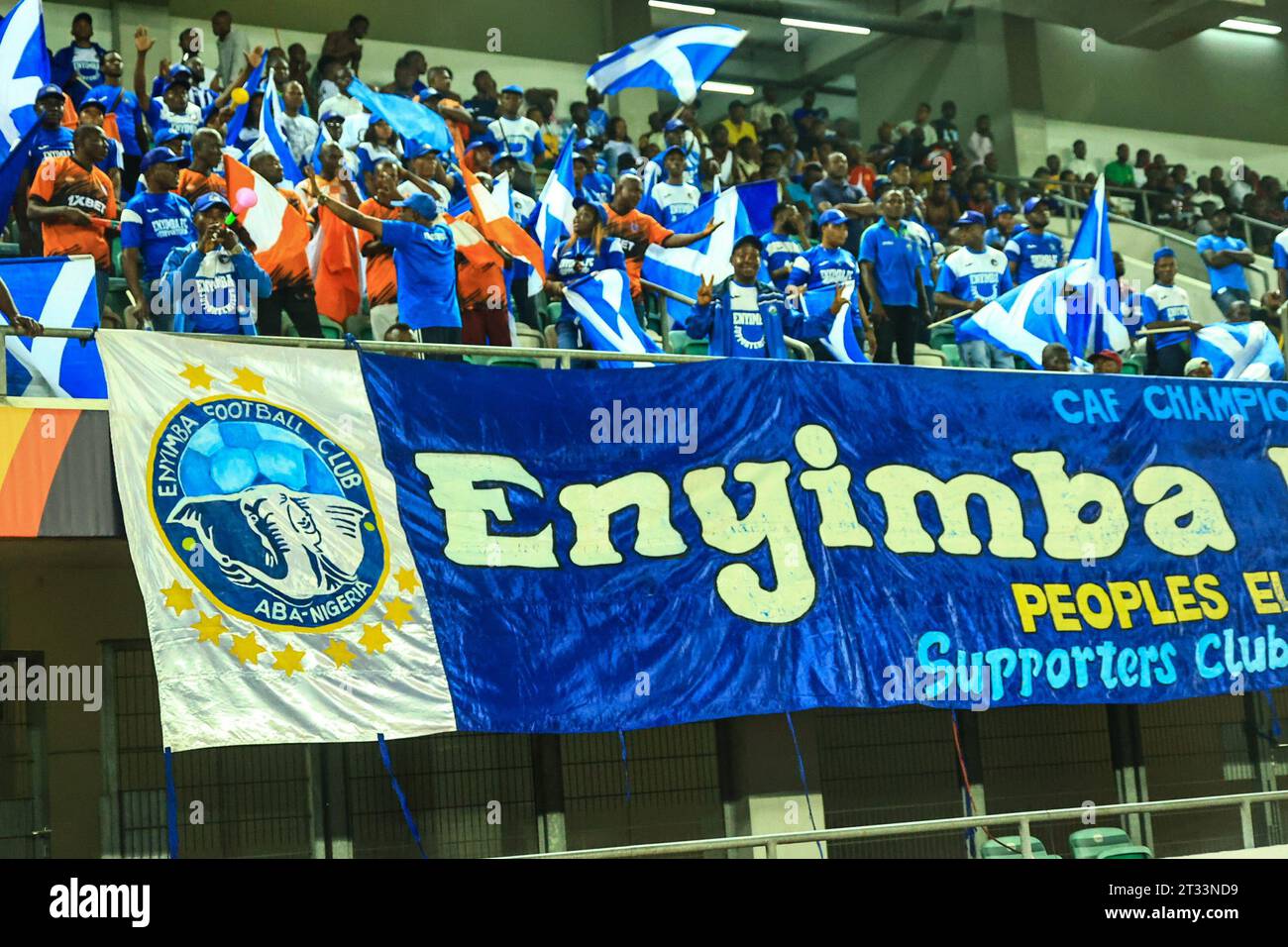
Here at Enyimba, we have repeatedly argued that loving the club does not mean defending every person occupying an office inside the club. Administrators come and go. Coaches come and go. Players come and go. Enyimba remains. The same principle should apply to Nigerian football. The NFF is bigger than whoever happens to be president today.
Support for leadership should therefore never become a reward for friendship, regional calculations, political alliances or promises of future appointments. It should be based on one simple question:
Is Nigerian football better today than when you met it?
That question should make everybody uncomfortable.
Because if missing three consecutive U17 World Cups, missing the U20 AFCON and U20 World Cup, missing back-to-back senior FIFA World Cups, and watching the Super Falcons record their poorest WAFCON performance cannot trigger serious accountability, then what exactly would constitute failure?
Do we have to stop qualifying for everything first?
Perhaps that is why Nigerian football keeps going around in circles. We complain when things go wrong, hold meetings, issue communiqués, promise reforms and then, when election season approaches, the same political machinery starts moving again. Suddenly results become secondary and mathematics becomes more important — who controls which state FA, who owes whom a favour, who can deliver which votes.
Meanwhile, Nigerian football waits.
Nobody should be automatically entitled to a second term simply because they have built the political structure to obtain one. A second term should be an endorsement of performance. And if the performance cannot justify the endorsement, then Nigerian football stakeholders should have enough courage to say: thank you for your service, but we need another direction.
Because positions in football administration are not an inheritance. And Nigeria is far too talented a football country to normalize failure simply because the people responsible have enough friends to survive it. At some point, results must matter. At some point, accountability must matter. And if Nigerian football cannot hold its leaders responsible after failure upon failure, then perhaps our biggest problem was never talent, coaching or even funding.
Perhaps our biggest problem is that we have made failure comfortable and reelecting this adminstration is borderline foolishness.
Because after everything we have seen under this NFF leadership, returning the same administration for another term and expecting a different outcome would not just be difficult to explain.
It would be borderline foolishness.
Written by BigSam
Passionate writer and analyst for That Enyimba Fan publication.
💬Fan Discussion (0)
No comments yet on this article. Be the first to share your reaction!
Leave A Comment
Your email address will not be published. Required fields are marked *